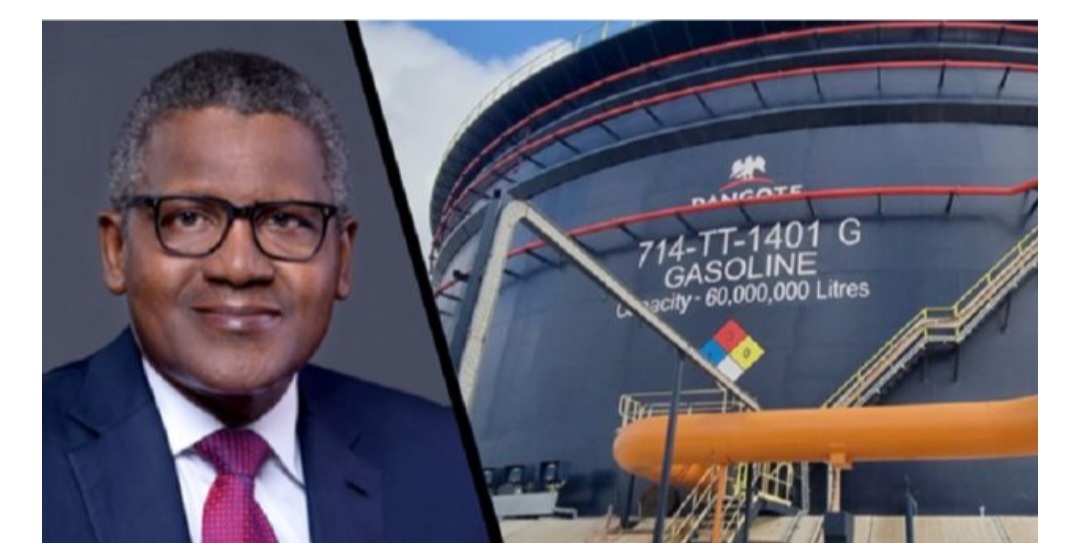
Nigeria’s downstream petroleum sector recorded another round of price reductions on Monday, as the Dangote Petroleum Refinery and several major fuel marketers lowered their depot prices for Premium Motor Spirit (PMS), popularly known as petrol, and diesel.
The latest price adjustments come amid increasing pressure from the Federal Government, stronger market competition and improved availability of petroleum products.
Before the price cuts were announced on Monday, the Minister of State for Petroleum Resources (Oil), Senator Heineken Lokpobiri, told stakeholders that the current retail price of petrol no longer reflects the sharp decline in global crude oil prices.
The meeting was convened by the Nigerian Midstream and Downstream Petroleum Regulatory Authority (NMDPRA) and attended by representatives of the Dangote Petroleum Refinery, the Major Energy Marketers Association of Nigeria (MEMAN), the Independent Petroleum Marketers Association of Nigeria (IPMAN), the Depots and Petroleum Products Marketers Association of Nigeria (DAPPMAN), the Nigerian Association of Road Transport Owners (NARTO), and the Petroleum Products Retail Outlets Owners Association of Nigeria (PETROAN).
Among the major depots in Lagos, NIPCO reduced its petrol price by N2 per litre to N1,076, while Pinnacle lowered its price by N3 to N1,075 per litre. Sahara, AIPEC and African Terminal each cut their petrol prices by N4, bringing their rates to N1,075 per litre.
Aiteo, however, retained its petrol price at N1,075 per litre.
Diesel prices also declined across several depots. Rain Oil reduced its Automotive Gas Oil (AGO) price by N15 per litre to N1,430, while Ibeto, Duport and Ibachem also lowered their diesel prices to N1,430 per litre. Dangote Refinery maintained its diesel price at N1,500 per litre.
In Port Harcourt, marketers recorded sharper price reductions. Matrix cut its petrol price by N8 per litre to N1,087 and reduced its diesel price by N55 to N1,465 per litre, the largest diesel price reduction recorded during the trading session.
Sigmund also lowered its petrol price by N12 per litre to N1,082, although it increased its diesel price slightly by N2 to N1,463 per litre.
The downward price movement was also recorded in other parts of the country. In Calabar, Fynfield reduced its petrol price by N7 per litre to N1,090, while Soroman lowered its price by N5 to the same level.
In Warri, Matrix and Prudent both reduced their petrol prices by N5 per litre to N1,085. For diesel, Prudent cut its price by N25 per litre to N1,475, while A.Y.M. Shafa reduced its diesel price by N3 to N1,455 per litre.
Industry analysts said the latest reductions reflect growing competition among suppliers, supported by increased local refining capacity and relatively stable international crude oil prices.
Speaking after the stakeholders’ meeting on the cost-reflective pricing of PMS, Lokpobiri said the Federal Government did not interfere when petrol prices increased due to higher crude oil prices, but maintained that current pump prices are no longer justified with Brent crude trading below $70 per barrel.
“NMDPRA never faulted anybody as far as the price was concerned because we are operating a fully deregulated economy.
“But deregulation doesn’t mean excessive profiteering. The Petroleum Industry Act also places responsibility on NMDPRA to ensure that steps are taken to prevent unnecessary profiteering.
“When Brent crude was about $118 per barrel, prices adjusted rapidly. Now that crude prices have dropped significantly, why has the pump price not come down in the same way?” he asked.
The minister said discussions with marketers were productive and would continue until an agreement is reached on a framework that ensures petrol prices better reflect changes in the international crude oil market.
“We had very fruitful and frank discussions with the marketers and leaders of the downstream sector with a view to driving down the price of PMS. The engagements are still ongoing.
“We told them the concerns of Nigerian consumers, and they have agreed to go back and think of what concrete steps can be taken. Discussions are ongoing, and we believe we are getting somewhere,” he said.
Also speaking, the Chief Executive of NMDPRA, Mallam Rabiu Umar, said the gap between falling international crude oil prices and unchanged domestic petrol prices made the engagement with marketers necessary.
He recalled that previous consultations with industry stakeholders helped reduce prices in the domestic Liquefied Petroleum Gas (LPG) market and expressed confidence that similar discussions would produce positive outcomes for petrol consumers.
“Deregulation is not a licence for market distortion or unfair consumer pricing. Sustainable profitability for marketers and consumer welfare are not mutually exclusive,” Umar said.
Meanwhile, the Independent Petroleum Marketers Association of Nigeria (IPMAN) said petrol prices could fall below N800 per litre as independent marketers begin sourcing products directly from the Dangote Petroleum Refinery.
IPMAN National President, Abubakar Garima, said the association has already reduced petrol prices by about N125 per litre across the country and would continue lowering prices whenever the cost of acquiring products declines.